
Class 8 English Bodo Medium Question Answer – Lesson 8: "Chandraprabha Saikiani"
Lesson 8
Chandraprabha Saikiani
(चन्द्रप्रभा सैकियानी)
ACTIVITIES
1. Answer the following questions from the lesson to check your comprehension:
(a) Who was Chandraprabha Saikiani?
Ans: Chandraprabha Saikiani was a renowned social reformer from Assam who fought to make formal education available for girls.
(b) What did Chandraprabha do to educate the girls of her village?
Ans: Chandraprabha gathered the girls of her village after school and taught them what she had learned during the day .
(c) Which two incidents show us how Chandraprabha fought for the rights of girls?
Ans: Two incidents that show Chandrapabha fought for the rights of girls are:
First, she fought for girls to be allowed admission to the school hostel without converting to Christianity.
Second, in 1925, she protested against the custom of women sitting behind a bamboo screen during public meetings.
(d) On what occasion did Chandraprabha Saikiani inspire women to come out from behind the bamboo screen?
Ans: Chandraprabha Saikiani inspired women to come out from behind the bamboo screen during the Assam Sahitya Sabha session at Nagaon in 1925, where she delivered a powerful speech demanding equal rights for women.
(e) What steps did Chandraprabha take to eliminate the caste system?
Ans: Chandraprabha Saikiani was deeply affected by the caste system in India. In her own state, Assam, she took bold steps to fight against it. One of her major efforts was to ensure the entry of everyone, irrespective of caste, gender, or class, into the famous Hayagriva Madhava temple at Hajo.
(f) What was Chandraprabha Saikiani's role in the freedom movement of India?
Ans: When Chandraprabha Saikiani met Mahatma Gandhi in 1921, she was inspired to join the freedom movement. She spread the message of khadi, boycott of foreign clothes, removal of untouchability, banning of opium and other social evils.
2. Work in pairs and complete the following sentences with information from the lesson:
(a) At a time when society did not allow young girls to step out of home, she
fought _____________________________________
____________________________________________
Ans: At a time when society did not allow young girls to step out of home, she
fought to make formal education available for girls.
(b) In those days girls' schools did not exist, so Chandraprabha ______________
________________________________________
Ans: In those days girls' schools did not exist, so Chandraprabha taught the girls of her village after school what she had learned during the day.
(c) Chandraprabha and her sister were awarded _______________________________
_________________________________________
Ans: Chandraprabha and her sister were awarded a scholarship to study in Nagaon Mission School.
(d) In order to eliminate the evils of the caste system, Chandraprabha fought
for the entry of _______________________
_______________________________________
Ans: In order to eliminate the evils of the caste system, Chandraprabha fought
for the entry of everyone, irrespective of caste, gender, and class, into the famous Hayagriva Madhava temple at Hajo.
(e) Being inspired by Mahatma Gandhi, Chandraprabha _____________________
______________________________________
Ans: Being inspired by Mahatma Gandhi, Chandraprabha joined the freedom movement and spread the message of khadi, boycott of foreign goods, and removal of untouchability banning of opium and other social evils.
3. Read the following sentences and find a word from the text to replace the underlined part.
(a) Chandraprabha Saikiani was a famous and respected social worker from Assam.
Ans: renowned
(b) She tried to get rid of all the cultural or religious restrictions against women that prevailed during those days.
Ans: taboos
(c) Chandraprabha refused to accept and questioned the prevailing custom of women sitting behind bamboo screens in public meetings.
Ans: challenged
(d) She was strong in her attitude against society's restriction and her protest against the norms of society was not confined to a particular incident.
Ans: staunchly
(e) Whenever she saw any injustice, her desire to resist authority rose to the occasion.
Ans: rebellious spirit
4. Listen to your teacher read out the first paragraph of the lesson. As you listen, complete the table below with information about Chandraprabha Saikiani:
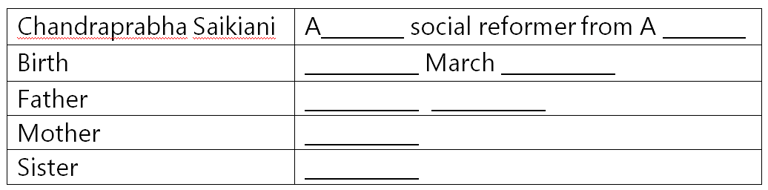
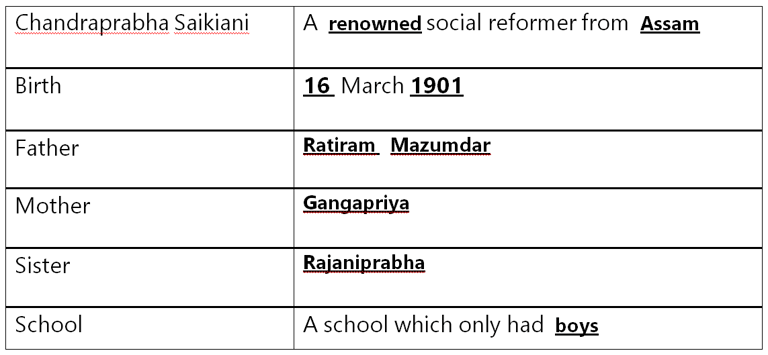
Ans:
5. There are seven paragraphs in the lesson Chandraprabha Saikiani. Choose the appropriate description for each paragraph.
(a) The first paragraph is about:
(i) Chandraprabha Saikiani's childhood
(ii) Chandraprabha Saikiani's birth as the social reformer
(iii) Chandraprabha Saikiani's career as a school teacher
Ans: (ii) Chandraprabha Saikiani's birth as the social reformer
(b) The second paragraph is about:
(i) Chandraprabha Saikiani's preparation to be a school teacher
(ii) Girl's education vs boy's education
(iii) Chandraprabha Saikiani's efforts to get an education just like the boys of her village
Ans: (iii) Chandraprabha Saikiani's efforts to get an education just like the boys of her village
(c) The third paragraph is about:
(i) her fight for freedom
(ii) her fight for the rights of girls
(iii) her fight against British rule
Ans: (ii) her fight for the rights of girls
(d) The fourth paragraph is about:
(i) formation of Assam Pradeshik Mahila Samiti
(ii) Chandraprabha Saikiani's protest against restrictions imposed on women
(iii) Chandraprabha Saikiani's speech at the Assam Sahitya Sabha meeting
Ans: (iii) Chandraprabha Saikiani's speech at the Assam Sahitya Sabha meeting
(e) The fifth paragraph is about:
(i) the caste system of India
(ii) Chandraprabha Saikiani's visit to Hajo
(iii) Chandraprabha Saikiani's protest against the caste system
Ans: (i) the caste system of India
(f) The sixth pragraph is about:
(i) Chandraprabha Saikiani's meeting with Mahatma Gandhi
(ii) Chandraprabha Saikiani as the freedom fighter
(iii) the punishment Chandraprabha Saikiani received for being a freedom fighter
Ans: (i) Chandraprabha Saikiani's meeting with Mahatma Gandhi
(g) The seventh paragraph is about:
(i) Chandraprabha Saikiani's rebellious spirit
(ii) Chandraprabha Saikiani's imprisonment
(iii) Chandraprabha Saikiani's motivation to join the freedom movement
Ans: (iii) Chandraprabha Saikiani's motivation to join the freedom movement
6. Discuss in groups and share what you have learnt about:
(a) The condition of women during the days of Chandraprabha Saikiani
Ans: (Do it in your class.)
(b) Chandraprabha Saikiani's role in the freedom movement
Ans: (Do it in your class.)
Your group leader will read your points aloud for the rest of the class.
7. Let's learn some grammar:
In this lesson you have come across verbs that use 'to' before them-
(a) She was inspired to join the freedom movement.
The form "to join" is a non-finite verb generally known as the to-infinitive.
The to-infinitive can also be used as the subject of a sentence as in-
(b) To keep the guests waiting is not good.
It can also be used as the complement of a sentence-
(c) It is not good to keep the guest waiting.
Now practise using the to-infinitive.
Combine these sentences by using to-infinitives. The first one is done for you-
(a) I will visit the book fair. I will buy a few novels.
Ans: I will visit the book fair to buy a few novels.
(b) We are going to Puri tomorrow. We will visit the Jagannath Temple there.
Ans: We are going to Puri tomorrow to visit the Jagannath Temple there.
(c) She started a small school for girls. She would help them to overcome
the taboos against women.
Ans: She started a small school for girls to help them overcome the taboos against women.
(d) She delivered a very powerful speech. She demanded the removal
of the prevailing customs of women sitting behind bamboo screens.
Ans: She delivered a very powerful speech to demand the removal of the
prevailing customs of women sitting behind bamboo screens.
(e) She and her sister were awarded a scholarship. They will study in Nagaon Mission School.
Ans: She and her sister were awarded a scholarship to study in Nagaon Mission School.